The Golden Record: A Journey Through Space and Time

Irene MartinkoBlog, Featured

On September 5, 1977, NASA launched the Voyager 1 space probe out of our atmosphere and into the cosmos.

Fast forward 44 years to 2021. This is when I read Jared Michael Delaney’s sci-fi play Voyager One for the very first time, and I’ll admit, I had absolutely no idea what the Voyager 1 space probe even was. Or I should say, what it is

Because yes, Voyager 1 is both very real and it’s still out there, journeying through interstellar space and collecting data on its path. And on Voyager 1, rests the Golden Record, shining in its case, ready to be deciphered by extraterrestrial life. 

Add this to the list of things I wish I’d learned about in school! 

Having now taken a dive into the real story behind the play, I’m absolutely fascinated by this piece of human history and, of course, regularly overwhelmed by the vastness of the universe and my little place in it. But existential crisis aside, let’s talk more about Voyager 1 and the Golden Record.

Voyager 1 was designed specifically to conduct research on planets within our solar system and beyond, into interstellar space, regularly communicating findings back to Earth so that we as a species could learn more about what’s out there. But NASA saw the potential in this mission for something even more special, and perhaps a little more unconventional.

Thus emerged the Golden Record. And yes, it is a literal record plated in gold. It contains music, “Sounds of Earth”, greetings in 55 different languages, and a series of images all designed to depict human life on Earth to any alien being who might come across it. The cover of the record is etched with pictures in an attempt to convey how a record should be played, and it was even sent with a cartridge and a needle. They really were trying to make extraterrestrial communication a little easier! 

It is, in essence, a veritable time capsule of humanity, capturing the hopes, the desires, the realities, and even the priorities of the United States in 1977. And now, it is the farthest man-made object from our very own planet… a little piece of the 1970s floating through interstellar space. 

What’s more, the people behind the Golden Record certainly left their mark on its contents. For instance, famous scientist Carl Sagan was put in charge of the NASA committee that set out to determine what would actually make it onto the record. You can now hear his laughter, captured in etchings and floating through space, as one of the “Sounds of Earth”. And his son, who was six years old at the time, recorded one of the English greetings, telling alien listeners, “Hello from the children of planet Earth”. 

Even romantic love made it onto the Golden Record. Ann Druyan, Creative Director of the project, had the brilliant idea of recording her own brain waves to be included on Voyager 1. She thought about many topics, including Earth’s history, civilizations and the problems they face, and what it was like to fall in love. And the beautiful thing? She was actually falling in love with Carl Sagan at the time. They married not long after and remained happily together for the rest of Sagan’s life. What could be more human than falling in love and wanting to tell the entire universe all about it?

Listening to the contents of the record on the internet using my modern-day laptop, I’m left with a feeling of curiosity and optimism, and that’s what I find so fascinating about this whole thing. There’s something so beautifully hopeful about the Golden Record. 

Over a year was spent determining what would go on this metal disc, what would perfectly encapsulate this intended image of humanity, and yet there was never a guarantee that the Golden Record would ever be found. We don’t know if there is life outside of our planet, and even if we did, there is no way of knowing that they would find Voyager 1, that they would be able to play the record, or that they would even understand what they had found. 

Yet, against all odds, NASA decided to move forward with this project anyway, because that unbelievably slim chance still made it all worth it.

If we were to make a version of the Golden Record today, I’m sure it would look pretty different. It likely wouldn’t be a record at all. After all, technology has changed quite a bit and continues to do so at a rapid pace. And I imagine there would still be a lot of debate about whether or not Johnny B. Goode should be the rock and roll song of choice. 

But I like to believe that our hope remains the same. We may not know what the future holds, but we can look at where we are now and think about where we’re going. We can work on doing better with every moment that we exist on this planet and in this universe, and we can hope that what we put out into the vastness of space is something positive, and something that reflects who we are.
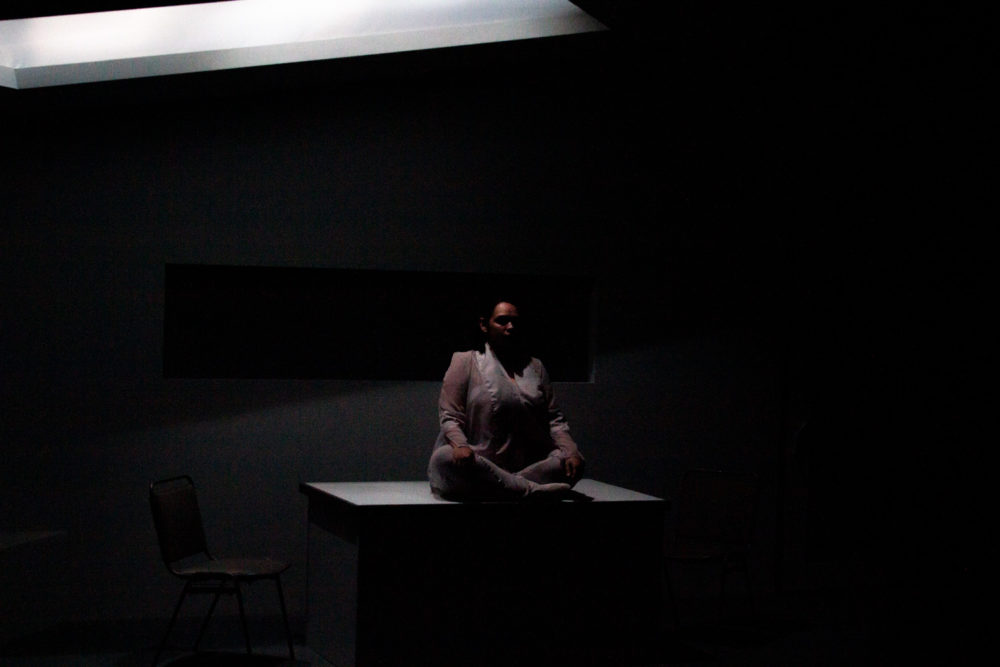
You can stream Voyager One by Jared Michael Delaney On Demand now through December 12. For more information, visit ptalaska.org.

Bringing Down The Heat: De-Escalation and Safety

Irene MartinkoBlog, Featured

If you’ve ever worked in customer service before, then you definitely know what it’s like to face a challenging customer. Maybe someone’s order isn’t exactly how they’d like it. Or perhaps, they’re frustrated by the time it’s taking for them to be served. These days, it may even be someone who is upset that they have to wear a mask indoors. 

But what happens when a situation like this escalates? How do you know what to do if someone gets so angry that you start to feel unsafe or concerned for the safety of those around you? 

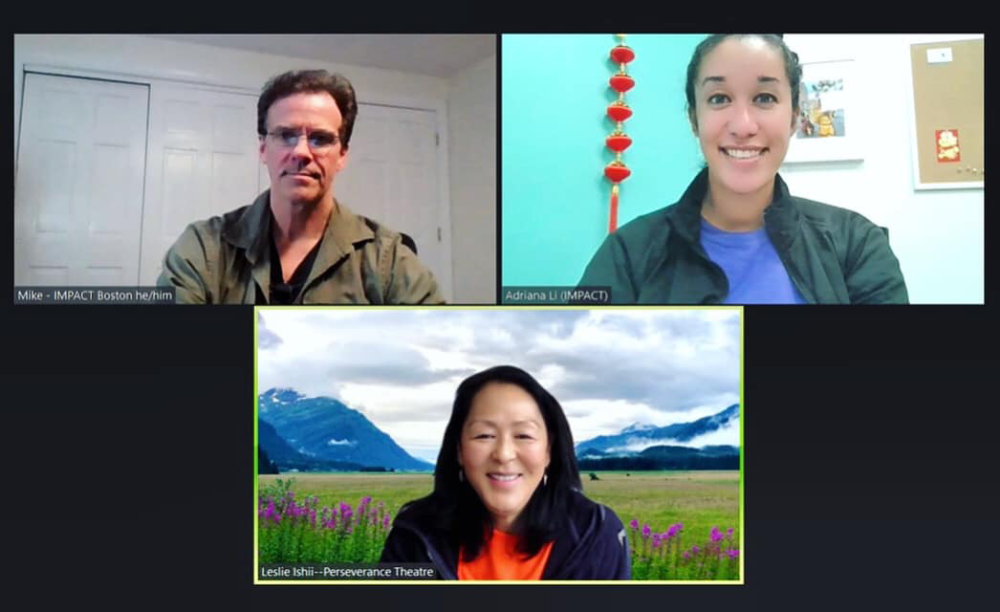
I had these same questions running through my head when I agreed to participate in a de-escalation training workshop taught by IMPACT Boston instructors Adriana Li and Michael Perry, and organized by Perseverance Theatre. How am I, a young woman with an almost comical lack of physical strength, supposed to handle a situation that goes too far?

So when the day came, I opened up my laptop, found a quiet space to focus, and got ready to listen.

Tuning in to the workshop Zoom meeting, it was exciting to see that in addition to my own, 57 other devices had also tuned in to receive this de-escalation training. With Arts and Culture leaders, staff, board members, volunteers, and even family members from organizations in Juneau, Anchorage, and Fairbanks, nearly 70 people gathered together to learn. The goal was to garner tools and skills to support community well-being and everyone’s safe re-opening.

But what exactly did we learn? 

To begin, Adriana and Michael from IMPACT Boston, an organization dedicated to teaching self-defense, assertive communication, and de-escalation skills, shared with us a simple message. We were told that the goal should always be to stop escalation before it can even become a fight. When it comes down to it, de-escalation is all about preventing violence before it actually occurs.

We began our training by learning about adrenaline. Have you ever heard an unexpected loud noise that startled you so much that you began to feel that familiar fight or flight response? Your heart rate increased, your breathing became rapid, and time may have even felt like it slowed down or sped up? That’s your adrenaline kicking in. And though in some situations, it may be what keeps you alive, it can also make it really hard to respond to a conflict in a way that is calm and effective.

Adriana and Michael taught us different ways to recognize that feeling of adrenaline in ourselves and how to spot warning signs of that same reaction in others. We were given exercises to manage our own adrenaline and to ground ourselves if we start to feel that fight or flight taking over. I found myself learning skills that would not only be helpful in a de-escalation situation, but also in any stressful scenario in which I might need to keep a clear head.


In fact, Michael even shared with us that we have been living with an unprecedented level of stress in our bodies since the beginning of the pandemic. We have experienced what feels like a constant state of uncertainty, change, and ongoing worry. He and Adriana emphasized that investing time in breathing, grounding ourselves, and practicing stress-relieving techniques has never been more important. 

We then moved into examples of escalated situations in order to learn how to navigate them. We were taught about the words we use, our body language, our tone of voice, and even the way that we stand. All of these things send a message to the people we interact with. In learning how to present ourselves, we are able to have some measure of control in a situation that could potentially become dangerous. 

But what I found most engaging about the workshop was the last section, when Adriana and Michael shared role-playing scenarios with us, demonstrating the very techniques we had just discussed. 

They started by presenting a lower stress scenario, the set-up being a theatre employee welcoming a patron into the space and reminding them that masks are required indoors. The patron is unhappy about said requirement, and thus the escalation, and subsequent de-escalation, ensues.

We watched as they acted out increasingly more intense versions of this scenario, and then we came together to discuss what we had just seen. Some students were even able to practice their own de-escalation skills by taking over the role of theatre employee in the scenario, acting out the situation and using their newfound knowledge to confidently manage the conflict. 

But why is this training important? Sure, it may help us now and again, but where else in our lives can it be used? 

I, for one, left this workshop feeling much more confident about my own ability to de-escalate and about staying calm and collected in stressful situations. As someone who has worked both as a house manager and in a box office, I am of the mindset that this kind of training should be given to anyone in a customer service position. This kind of knowledge can only provide an additional level of safety and security to both employees and patrons in essentially any workplace setting.

But beyond that, de-escalation training is a step that we can take to learn how to protect both ourselves and others in our community in our everyday lives.

Say you’re walking down the street, and you witness a conflict that has the potential to escalate. Perhaps you see someone approach another with comments of racism, sexism, or homophobia. Groups that face elevated levels of discrimination in this country are of course more likely to see this kind of violence. De-escalation training gives us the skills to feel as if we can move from bystander, simply watching the events unfold, to upstander, the kind of person who feels as though they can de-escalate the situation and stand up for their fellow community members.

It reminds me of the TV show “What Would You Do?”, a program on ABC in which actors play out scenarios in public spaces to see if anyone will step forward to intervene. They create fabricated scenarios such as a customer making anti-Muslim comments to a Muslim cashier, or a restaurant refusing to serve a gay couple, and then they see what the real-life public will do. The hidden cameras always capture people who intervene and others who silently watch the situations unfold. When we open ourselves up to learn more about de-escalation tactics, we can become the kind of people who are able to intervene.

I hope that we at Perseverance continue to do this kind of training and work. Attending one workshop was beyond valuable, but I feel as though we have more learning to do, and I can personally say that I’m excited to do it. I also can’t even begin to say how comforting it is to see so many organizations in Alaska who are enthusiastic to learn along with us. Together, we can continue to learn these skills and keep our communities safe.

In-Person Seating Update

joshuaFeatured, News

As the team at Perseverance Theatre gears up to open our doors to the community once again, we are working tirelessly to ensure that our organization can continue to mitigate any potential harm as a result of COVID-19 transmission. It is with this in mind that the following policies exist – Perseverance Theatre strives to be of service to the community in all that we do, including protecting the health of our neighbors.

Since the postponement of our production of Fun Home, we have been monitoring any updates provided by the Center for Disease Control, the Alaska Department of Health and Social Services, the City and Borough of Juneau, and Dr. Anne Zink and reflecting those updates in our policies through the summer. Thanks to the tremendous efforts of scientists and health professionals across the globe, Perseverance Theatre was able to open our doors to students aged 12-18 for the 2021 STAR Program. We implemented the following policies and saw tremendous success in preventing the transmission of COVID-19 within our facilities. See our full list of guidelines below.

PERSEVERANCE THEATRE COVID-19 PROTOCOL FOR AUDIENCES AND GUESTS

Health Screening

Attendees must provide proof of vaccination against COVID-19 completed at least two weeks prior to the event.

Proof of vaccination must be in the form of a vaccine card or official record or a photo of a vaccine card or record and a matching photo ID.

Prior to entry to the theatre, Perseverance Theatre patrons will be greeted by our staff and will be screened via questionnaire for symptoms of COVID-19. All patrons will have their temperatures taken via contactless thermometer. If a temperature of 100.4 degrees fahrenheit or greater is taken,you will be asked to wait in a designated area for 10 minutes. Your temperature will then be taken again, if it remains elevated you will be asked to return home and we will work with you to reschedule your ticket.

Masks Required

All audience members are required to wear properly fitting masks or face coverings that cover the nose and mouth when inside Perseverance Theatre facilities. Staff are required to wear masks as well. If you do not have a mask with you, Perseverance Theatre will provide you with a mask, free of charge.

As an arts organization, we feel enormously fortunate to have the opportunity to once again welcome the community to our space while producing opportunities for artists to share their gifts. As audience members, we invite you to play your part by keeping our cast and crew safe so that the show may go on.

We look forward to seeing you again.

Curtain Up!: The Return of In-Person Theatre

Irene MartinkoBlog, Featured

Flashback to March 2020: 

I’m sitting in a darkened theatre waiting for the show to begin. The music plays, the actors take the stage, and soon I find myself immersed in the beautiful story of Fun Home, the musical that was meant to complete Perseverance Theatre’s 2019/2020 season. By the end of this dress rehearsal, I’m in tears, deeply moved by what has just unfolded onstage, and full of excitement for an audience to see what I’ve just seen. The set is nearly finished, the actors are in costume, and we’re supposed to be celebrating opening night in just a week and a half.

We had no idea that we were so close to the world shutting down. 

Okay, yes, I may sound a bit overdramatic, but the whiplash of finding ourselves on the verge of opening our final show of the season to shutting down the theatre with no end in sight was completely overwhelming.

I suddenly found myself leaving Juneau to be with my family, terrified of catching COVID in the airport, and thinking that we’d be back in just a few short months. Turns out it would be at least a year before we could even think about the possibility of safely returning.

Ask anyone and they’ll tell you that the past year and a half has been incredibly difficult and full of loss. And for those of us who work in theatre, the changes we’ve felt have been devastating. Countless people found themselves out of a job, theatres across the country darkened their lights and closed their doors, and live in-person theatre was almost nowhere to be found.

Of course, I would never devalue the amazing work that was done, and continues to be done online. In creating virtual theatre, we found ways to collaborate across state and country lines, to reach audiences we had never reached before, and to create innovative ways to use technology in our art. Theatres across the world came up with creative solutions to problems we had never dreamed we would experience. And I for one hope that we’re able to continue to use the techniques we’ve developed, even as in-person performance returns.   

But I also can’t pretend that in remaining virtual, I didn’t feel like something was missing. It’s because of this, that as I write about the return of in-person performance, I find myself almost unable to comprehend the possibility of sitting in a theatre and once again waiting for the show to begin.

But returning to in-person theatre has finally become a reality. 

After the shutdown on March 12, 2020, Broadway officially reopened over a year later on June 26, 2021 with the return of Springsteen on Broadway, Bruce Spingsteen’s one-man acoustic show that originally premiered in 2017. This was followed by the play Pass Over by Antoinette Chinonye Nwandu in August, Hadestown by Anaïs Mitchell in September, and many more, including Hamilton, Waitress, Wicked, and The Lion King

Suddenly I’m opening my social media and finding it full of videos of Broadway opening numbers, curtain calls, and rehearsals in celebration of reopening, complete with a never ending stream of comments about the tears these videos have brought to people’s eyes. My friends are once again posting pictures of playbills as they wait for the curtain to open for the first time in what feels like an eternity.

Of course, we do have to ask, is attending a Broadway show the same as it was before? Yes and no. There are definitely some key differences. For instance, in order to attend a live production on Broadway, audiences are now required to show proof of vaccination and must wear a mask. Productions have now essentially cut intermissions out entirely and are no longer allowing autograph signings at the stage door. Some productions have even shortened to ninety minutes in order to remain as safe as possible. For example, Harry Potter and the Cursed Child, which was originally written and produced as a two-part play, was transformed into one shorter play.  

Safety is now an absolute priority on Broadway, and they’ve set an important benchmark for theatres across the country. In order to create art that is meaningful, entertaining, and important, it is crucial that those backstage, onstage, and in the audience feel safe and comfortable.

And we’re seeing other theatres follow suit. For instance, Woolly Mammoth in Washington, D.C. has transitioned to virtual ticketing and playbills in order to reduce potential touch points. Nine arts organizations in Sarasota, FL grouped together to create COVID safety protocols collaboratively and have agreed to follow those protocols as they reopen. Oregon Shakespeare Festival has implemented socially distanced seating in order to maintain those six feet we’ve become so familiar with. Theatres are prioritizing safety, while adapting and working together to continue to find ways to create.

And when it comes down to it, the shows themselves and the essence of live performance is still the same. In fact, it may even be more exciting and full of hope simply because we’ve been desperate for it for so long. 

I know that I for one am longing for that sense of community and human connection that can only come from experiencing a story together and connecting with each other in the same space. I want to laugh together, cry together, and clap together as the actors return to the stage. I want to celebrate the actors, designers, technicians, directors, administrators, and more who have made these shows possible, and I want to feel a sense of normalcy after such a long period of change.

Perseverance Theatre team spending time on Lingít Aaní prior to the start of Voyager One rehearsals, our season opener and return to live performances

Following Broadway’s footsteps, and of course, paying close attention to the guidelines and recommendations of our own state, Perseverance Theatre is finally planning our own return to live in-person theatre.

I can’t pretend it’s been easy, especially as COVID numbers in Alaska change day by day. But the hope that I feel as we work towards a safe reopening makes it all feel worth it. As we create our safety protocols and prepare our space for audiences once again, I find myself feeling grateful that I live in a place that values the safety of our community along with the art that we work so hard to create and share.

Think about what you miss about live theatre. Imagine you’re sitting in that darkened space waiting for the show to begin. Hear the music play and feel the excitement as the audience quiets down and the actors take the stage. The anticipation and joy of live theatre may not be as out of reach as it feels. I hope you feel the same hope that I do, and I can’t wait to see you in the theatre soon.

STAR Final Showcase – VIRTUAL and IN-PERSON Tickets Available

Lewis ChapmanCurrent Projects, Education, Featured, Live Stream, Productions

Wednesday, August 4
7:00 P.M.

The talented Young Artists of STAR have been working together over the last few weeks to make unique performance pieces that showcase their individual talents and passions. Come see them perform, live or in-person, on Wednesday, August 4 at 7 p.m.!


Only 25 tickets are available for the in-person performance at the theatre on Douglas, so get yours soon! Masks covering nose and mouth will be required.


In-Person Tickets: $10
Virtual Tickets: $5